
In the field of construction diagnostics and litigation, water testing is frequently used to find the source of water intrusion, and less frequently, to proof test prototypical repairs. Selecting the type of test and conducting it properly is important, not only so that it will be an effective diagnostic tool, but also so that it will be credible if presented in court in conjunction with expert testimony.
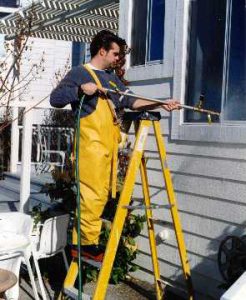
Technician from Interactive Resources, Inc. conducting AAMA 501.2, Field Check of Metal Storefronts, Curtain Walls, and Sloped Glazing Systems for Water Leakage, CC-ND
Even among experienced professionals, the type of testing most frequently used is a garden hose with an adjustable nozzle, operated in a manner dictated by the immediate objective of producing or replicating a leak. The water pressure, spray pattern, distance from target, angle of attack, and time of exposure are determined in the field to suit local conditions. While this may be effective as a diagnostic exercise, it has the disadvantage of potential criticism for a lack of objectivity; that is, producing results that do not replicate expected environmental conditions. An example would be the production of a test leak by pointing a nozzle at a void up under a soffit that would normally not be subject to wind-blown rain.
To counter criticism involving objectivity as well as to provide reliable results, test procedures sanctioned by established industry associations and standards organizations are available. Relatively simple and inexpensive is the Architectural Aluminum Manufacturers Association (AAMA) 501.2, Field Check of Metal Storefronts, Curtain Walls, and Sloped Glazing Systems for Water Leakage (see photo on right). Used for exterior windows, curtain walls, storefronts, sloped glazing systems, doors, and other wall components, this test method is similar in concept to the simple garden hose spray method. It is most effective for joints that are designed to be permanently closed or watertight. Often referred to or described as the Hose Test Method, it involves the use of a calibrated hose nozzle to deliver water to the test specimen at prescribed pressures. The test procedure consists of systematically wetting the test specimen with water from the spray nozzle that is held at a distance of 12 inches from the joint. The nozzle is moved slowly back and forth above the joint covering approximately 5 lineal feet of joint during a 5-minute period.
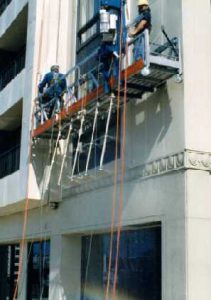
ASTM E 1105 Chamber Test with Spray Rack Administered by Calvin Chooey, AIA, of Interactive Resources, Inc.
A more sophisticated and more expensive test is described in American Society for Testing and Materials (ASTM) E-1105, Field Determination of Water Penetration of Installed Exterior Windows, Curtain Walls and Doors by Uniform or Cyclic Static Air Pressure Difference (see photo below). This method is useful for determining the in-place performance of a specimen when subjected to a prescribed rate of wetting under a defined static pressure difference. This method is often referred to as the Chamber Test Method, or differential pressure method, because it requires that a test chamber be installed either on the exterior or interior side of the test area. The test procedure consists of delivering water to the exterior from a calibrated spray rack at a minimum rate of 5gal/ft2/hr while simultaneously applying a specified differential pressure across the specimen.
The test can be performed for a duration of 15 minutes of static pressure or in a cyclic procedure in which the differential pressure is applied for 5-minute durations with 1-minute interruptions of no differential pressure and only water spray.
Selection of the appropriate test method involves issues of time, money, equipment, and test objectives. Following is a checklist of selection criteria:
Hose Test Method
- Best suited for non-operable joints
- Is dynamic type water test
- Simulates water penetration forces such as:
- Kinetic Energy
- Gravity
- Surface Tension
- Capillary Action
- Does not simulate water penetration forces such as:
- Air Currents (percolation)
- Is a good method for determining known leak paths and trouble shooting
- Is an accepted method for performing field quality assurance testing
- Is generally less expensive than chamber testing
- Involves relatively simple and inexpensive equipment and fewer personnel to operate
Chamber Test Method
- Uses the same test methodology followed for product certification and determining water penetration performance ratings
- Simulates water penetration forces such as:
- Pressure Difference (static/cyclic)
- Gravity
- Surface Tension
- Capillary Action
- Air Currents (percolation)
- Does not simulate water penetration forces such as:
- Kinetic Energy
- Is a good method for diagnosing water penetration that occurs under wind driven rains
- Can be much more expensive than hose test method
- Requires more specialized testing equipment and instrumentation
- Requires skilled and experienced operators
- Is an accepted method for performing field quality assurance testing
- Includes the effects of load deformation on system components.
A third simple test is described as an “optional test” under AAMA 502, where water introduced into the sill section of a window assembly with the weep holes plugged. If the water level is observed to drop over a period of time, it indicates that there may be a leak at a jamb-sill joint. Typically, finishes have to b removed to confirm internal leakage of this type.
A thorough analysis of the project objectives should be made as a part of the selection of the appropriate test method.